
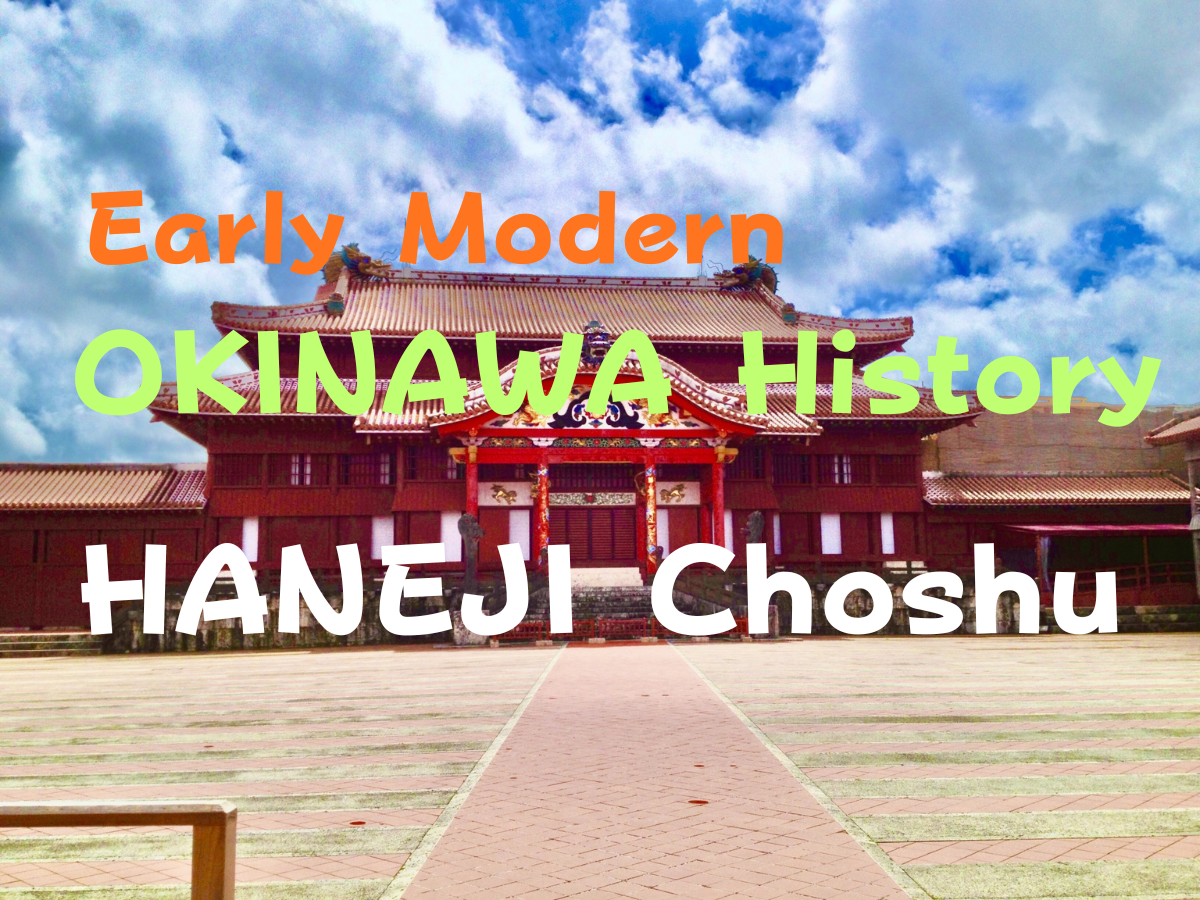
When discussing the early modern history of Okinawa, one cannot overlook Haneji Choshu (1617–1676) and his spiritual successor, Sai On. Haneji spearheaded sweeping political reforms and fiscal reconstruction during his tenure.
Born in 1617, Haneji Choshu became the Sessho (Regent) of the Ryukyu Kingdom in 1666. He initiated a variety of reforms that were later expanded upon by Sai On (born in 1682), who carried Haneji’s torch into the next generation.
In the context of the Edo period’s Bakuhan system, Haneji’s role is comparable to Yamada Hokoku of the Bitchu-Matsuyama Domain, who led late-Edo fiscal reforms. One might also compare him to Uesugi Yozan; though their positions differed, both famously resurrected their domains from the brink of financial collapse.
In this blog post, I will first focus on Haneji Choshu, one of the two great figures who restored the kingdom’s bankrupt finances. In the next installment, we will look at Sai On, all while providing an overview of the complex political landscape surrounding Ryukyu at the time.
The International Climate of the 17th-Century Ryukyus
Following the victory at the Battle of Sekigahara in 1600, the Shimazu clan (Satsuma Domain=Kagoshima Prefecture) found themselves under financial pressure within the Tokugawa framework. Seeking a way out, they invaded Ryukyu in 1609. While the Sho Dynasty was allowed to remain, Ryukyu was placed under the de facto control of the Satsuma Domain. Subsequently, the Ryukyuan government became divided between those who harbored resentment and resisted Satsuma, and those who sought practical benefits through cooperation. These factions clashed repeatedly, both openly and behind the scenes.
Furthermore, mainland China was in upheaval. The Ming Dynasty, which had lasted nearly 300 years since the 14th century, fell in 1644, giving rise to the Qing Empire established by the Manchus. The 17th-century Ryukyu Kingdom was truly caught in an era of global turbulence.
What is “Sakuhou” (Investiture)? An ancient Chinese system where the Emperor formally appointed and granted status to lords or kings of neighboring countries through an imperial edict called a Saku.
While the rise and fall of these empires had long interrupted the investiture process, the new Qing Dynasty finally resumed it in 1663. However, a scandal erupted involving Chatan Oyakata (sent as an envoy to give thanks) and Ezo Oyakata (sent to congratulate the ascension of the Kangxi Emperor). They allegedly masterminded a plot in Fuzhou—en route to Beijing—to stage a robbery of the ceremonial gifts and an attempted poisoning of the delegation. Satsuma’s investigation revealed the crime was a “self-staged” act by the envoys themselves.
The perpetrators were severely punished. Consequently, in 1666, Haneji Choshu—who had a long-standing friendship with the Satsuma elder Niiro Matazaemon—was appointed to the highest administrative post of Sessho (Regent) at the behest of Satsuma.
The Life of Haneji Choshu
Born into the Ryukyuan royal family, Haneji was a cousin to King Sho Shitsu. He showed a keen interest in politics and economics from a young age. In his teens, he attended lectures on Confucianism and traveled throughout the kingdom’s Magiri (administrative districts) and villages to personally investigate the realities of rural life.
At age 16, he had the opportunity to study Confucianism under the renowned scholar Tomari Jochiku (born on Yakushima), who was a tutor to King Sho Ho in Naha. After years of diligent study, Haneji was commissioned by King Sho Shitsu in 1650 to compile the “Chuzan Seikan”, the first official history of the Ryukyu Kingdom.
The Chuzan Seikan
Written in six volumes using a mix of Kanji and Kana, this work depicts the Ryukyuan dynasties—from the creation myths through the Shunten, Eiso, and Satto lines to the First and Second Sho Dynasties—as a single, continuous lineage. It incorporated the “Minamoto no Tametomo” legend, claiming the famous Japanese warrior fled to Ryukyu to found the dynasty, making the first King Shunten the son of Tametomo.
Notably, the text omits mentions of King Sho Shin (the architect of the dynasty’s peak) or King Sho Nei (who fought against Satsuma), suggesting a degree of “reading the room” (sontaku) regarding the Satsuma Domain. Haneji also used Japanese era names and attributed the 1609 invasion to the “wickedness” of a high-ranking official, Jana Oyakata—essentially a creative fabrication intended to appease the Shimazu clan.
While the Chuzan Seikan was submitted to Satsuma in 1698 (after Haneji’s death), I interpret his motives as follows: By using a Confucian framework to establish the dynasty’s legitimacy through a lineage connected to the Minamoto clan, Haneji held a fervent wish to protect the Sho Dynasty from Japanese encroachment and ensure its long-term survival even after his passing. What are your thoughts on this?
Reforms for Modernization
In 1660, a massive fire completely destroyed Shuri Castle. Despite the financial hardship stalling its reconstruction, Haneji’s appointment as Regent in 1666 changed everything. By 1671, through his fiscal reforms, the castle was rebuilt to be even more magnificent than before.
Here is a summary of the administrative reforms Haneji Choshu implemented:
- Restructuring the Government: He reformed the Hyojojo—the central organ controlling judicial, legislative, and administrative powers—to streamline the organization and clarify accountability.
- The “Haneji Shiki” (Haneji’s Ordinances): A series of directives aimed at fiscal improvement, including:
- Enforcing frugality and prohibiting luxury for everyone from the royalty to commoners.
- Regulating public morals and simplifying gift-giving.
- Eliminating the political interference of priestesses (Miko) and court ladies.
- Tightening crackdowns on official corruption.
- Encouraging land reclamation to revive rural areas.
- Promoting arts and sciences: scholarship, mathematics, calligraphy, medicine, cooking, flower arrangement, and tea ceremony.
- Establishment of a Confucian Social Hierarchy: Under Satsuma’s rule, it became necessary to clarify land ownership and conduct religious censuses. Haneji established a strict class system between warriors (Shi) and commoners. He also introduced “Patrilineal Logic” and “Ancestral Rites,” shifting the unit of governance from the individual to the “Household” (Ie).
- Suppression of Temples and Promotion of Confucianism: While Buddhism had flourished in Okinawa before the invasion, Haneji aligned with the Edo Shogunate’s 1662 restrictions on Buddhist activities. He suppressed Buddhist influence in favor of Confucianism. The current Confucius Temple in Kume, Naha, was authorized for construction during his regency.
Haneji pushed through these revolutionary—and sometimes forceful—measures to modernize aging customs and rescue the royal treasury. His success was undoubtedly bolstered by the backing of the Satsuma Domain (especially his friend Niiro Matazaemon) and the absolute trust of his cousin, King Sho Shitsu.
After serving as Regent for nearly eight years (1666–1673), Haneji Choshu passed away in 1676. His legacy and vision were eventually taken up by the reforms of Sai On in the early 18th century.








Comments