Comparing Japan and the West in the Race for the “Sun on Earth”
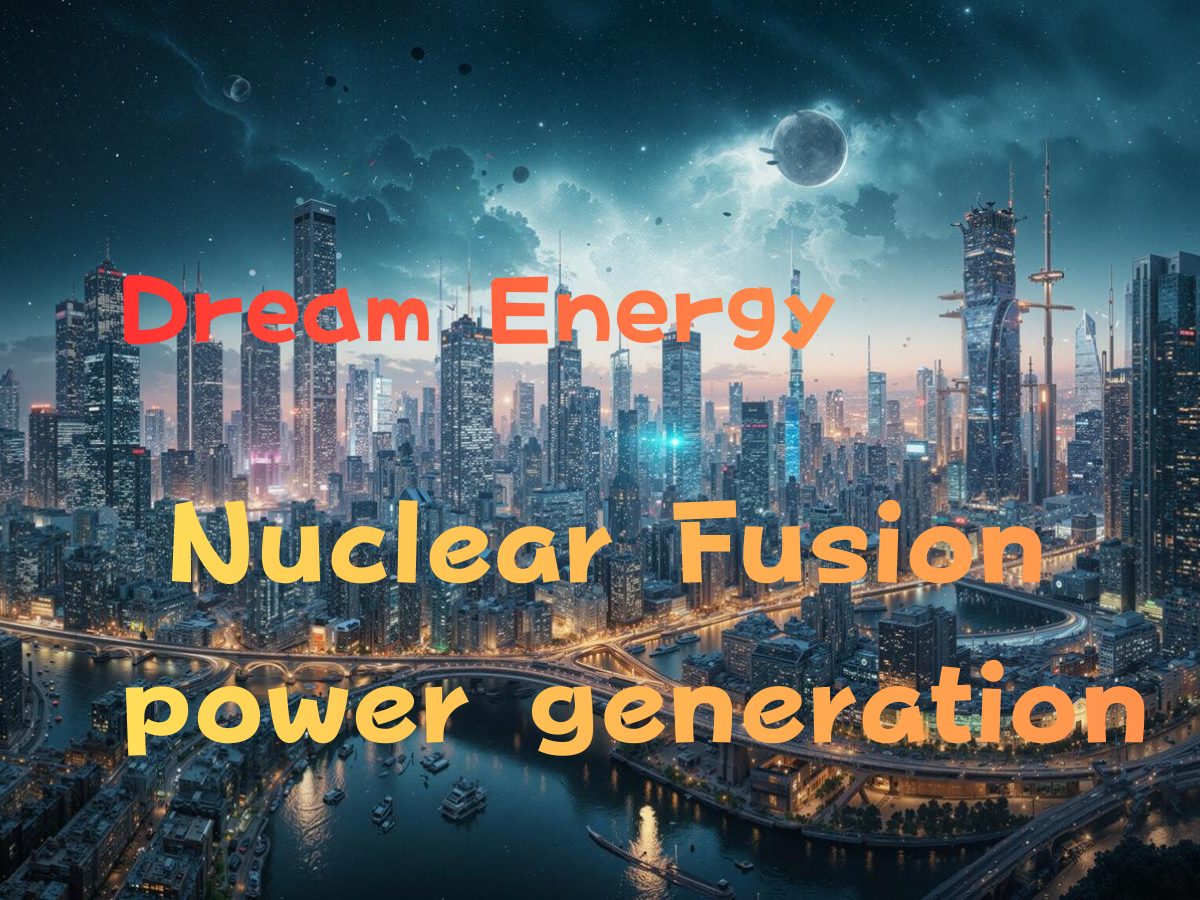
Recently, “Nuclear Fusion” has become a hot topic in newspapers and mass media. Often called the “dream energy,” it is considered the ultimate solution for stopping global warming.
In this report, we will explore the technology behind it, how it differs from conventional nuclear power, and the future outlook through a comparison of Japanese and Western perspectives.
Nuclear Fusion vs. Nuclear Fission: What’s the Difference?
While both generate energy from atoms, their processes, benefits, and risks are worlds apart.
Basic Process
- Nuclear Fusion: This involves light atomic nuclei (primarily hydrogen isotopes: deuterium and tritium) fusing together under extreme temperature and pressure to form a heavier nucleus (helium). This process releases massive amounts of energy.
- Example: Hydrogen nuclei fusing into helium.
- Key Fact: This process emits zero CO2.
- The Scale: Our sun generates energy equivalent to 5 trillion Hiroshima-class atomic bombs every second through fusion. This is why fusion is often called “The Sun on Earth.” ☀️
- Nuclear Fission: This is the process currently used in nuclear power plants. A heavy nucleus (like Uranium-235) absorbs a neutron and splits into two or more lighter nuclei, releasing energy and more neutrons.
- Example: Uranium-235 splitting into barium and krypton.
Energy Output
- Nuclear Fusion: Fusion converts “mass defect” into energy. Just 1 gram of hydrogen can release energy equivalent to 8 tons of oil (an entire tank truck). 1 kg of hydrogen can produce approximately 24,000 MWh.
- Nuclear Fission: While powerful, it is less efficient than fusion. A single fission of Uranium-235 releases about 200 MeV, requiring many reactions to match fusion’s output.
Byproducts and Waste
- Nuclear Fusion: The main byproduct is helium. It produces very little radioactive waste and no long-lived high-level waste. Furthermore, deuterium can be extracted from seawater, making the fuel source virtually inexhaustible.
- Nuclear Fission: Produces large amounts of radioactive waste, including isotopes that remain dangerous for thousands of years, requiring complex long-term management.
Safety and Risks
- Nuclear Fusion: It is inherently self-limiting. If the reaction conditions (temperature/pressure) fail, the plasma cools and the reaction stops naturally. There is no risk of a runaway chain reaction.
- Nuclear Fission: Relies on a chain reaction. If control is lost, it can lead to a meltdown, as seen in the Fukushima Daiichi accident.

2. Human Health Impact
- Nuclear Fusion: While the process involves radiation, the primary product (helium) is non-radioactive. Proper shielding is required for neutrons, but the overall risk to the public is considered significantly lower than fission.
- Nuclear Fission: Radioactive materials like Strontium-90 and Cesium-137 pose serious health risks, including radiation sickness and long-term cancer risks. Accidents can necessitate large-scale evacuations.
Summary: Nuclear fusion is clearly superior in terms of efficiency, safety, and waste management. Solving the “nuclear waste problem” may be its greatest advantage.
3. Japan vs. The West: The Global Race
How does Japan’s approach compare to the US and Europe? Let’s look at five key areas.
| Category | Japan | The West (US/Europe) |
| Major Projects | National Fusion Research Institute, Tsukuba University, and the JT-60SA (next-gen reactor). | ITER (France), Lawrence Livermore National Lab (LLNL), and the National Ignition Facility (NIF) in the US. |
| Technical Approach | Focused heavily on the Tokamak method (using magnetic fields to trap plasma). | While Tokamak is the standard, they also explore diverse designs like the Stellarator (e.g., Germany’s Wendelstein 7-X). |
| Commercial Goals | Aiming for commercialization by 2050. | Aiming for the 2030s–2040s. The US startup CFS recently announced a 2027 operational goal. |
| Funding | Primarily government-funded, though private participation is slowly growing. | High private sector investment. Numerous startups are competing fiercely with significant venture capital. |
| International Cooperation | A key player in ITER. Japan is collaborative but cautious regarding sensitive tech sharing. | Strong emphasis on international frameworks and active debate on setting global regulatory standards. |
Note: ITER (International Thermonuclear Experimental Reactor) is a massive 7-member collaboration (Japan, US, EU, Russia, Korea, China, India). Due to component adjustments, its first plasma goal was recently moved from 2025 to 2035.
4. Conclusion: A Necessity for Our Future
As AI continues to evolve and developing nations grow, humanity’s demand for electricity will skyrocket. Fossil fuels are finite and accelerate global warming, while clean energy alone may not meet the massive scale of future needs.
Traditional nuclear power remains plagued by safety and waste concerns. When we face these realities, it is no exaggeration to say: There is no solution to global warming without nuclear fusion.
It is my sincere hope that Japan’s public and private sectors unite to lead the development of this “Sun on Earth” for the sake of humanity’s future.







Comments