
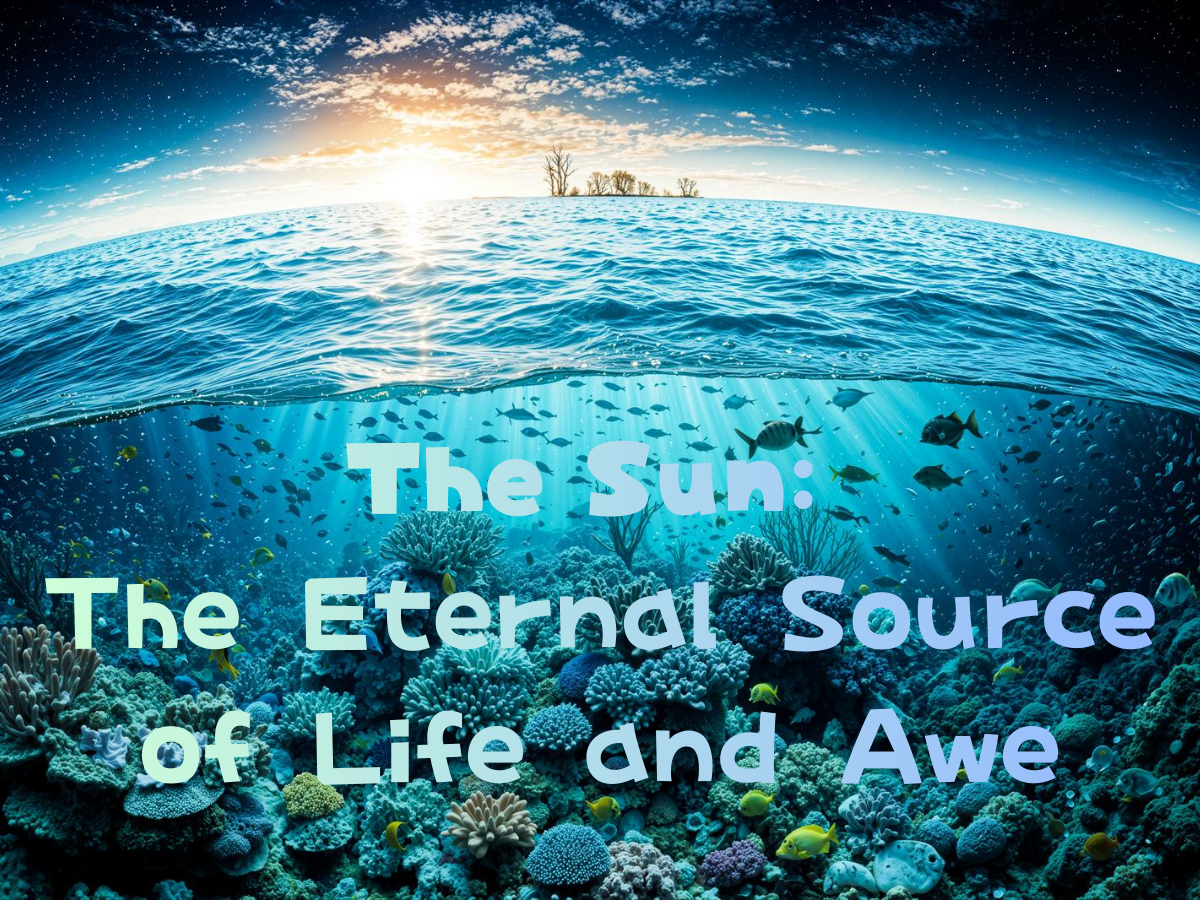
On sunny days, the sun naturally rises in the east and sets in the west. Long ago, during the Asuka period, Prince Shotoku sent a letter to the Emperor of the Sui Dynasty in China, writing: “The Son of Heaven in the land where the sun rises sends a letter to the Son of Heaven in the land where the sun sets. I hope you are well.” Even further back in the age of mythology, the supreme deity Amaterasu Omikami was a sun goddess. Since ancient times, the people of our nation have revered and stood in awe of the sun.
Needless to say, the Earth we inhabit is one of the planets orbiting the sun, and all forms of life, including humanity, could not exist without it. I would like to take a moment to reflect once again on what kind of existence the sun truly is.
What is the Sun ?
Simply put, the sun is a massive sphere of gas and one of the many stars in the Milky Way galaxy. Among those stars, it is considered quite an ordinary one. It is located 150 million kilometers away from Earth, with a diameter of approximately 1.39 million kilometers. While these distances are hard to wrap one’s head around, consider that the distance between the Earth and the Moon is 382,000 km. This means the distance to the sun is slightly less than 400 times the distance to the moon, and the sun’s diameter is about 3.6 times the distance between the Earth and the Moon. When you gaze at the distant full moon in the night sky, you can start to get a sense of the sun’s immense scale.
It is said that 13.7 to 13.8 billion years have passed since the birth of the universe. The sun was born about 8.7 billion years after that—roughly 5 billion years ago. This giant gas sphere is composed mostly of hydrogen and helium. In its core, immense energy is generated through nuclear fusion, primarily involving hydrogen, and this energy is radiated in all directions across the universe, including toward Earth. In the 5 billion years since its birth, the sun has consumed about half of its primary elements. Its remaining lifespan is said to be about another 5 billion years.
The Sun and Life on Earth
About 400 million years after the sun was born, our Earth came into existence. It is said that the atmosphere of the primordial Earth, much like Jupiter and Saturn today—and indeed like the sun—consisted mostly of hydrogen and helium. On the other hand, for animals to venture from the sea onto land alongside plants, oxygen was required as a source of energy. Or perhaps it is more accurate to say that through the fluctuations and circulation of atmospheric components described below, oxygen came to occupy about 20% of the atmosphere, leading to the emergence and evolution of animals that use oxygen as an energy source.
Life forms born in the oxygen-free oceans spent vast amounts of time evolving. Eventually, they became algae and flourished in the shallow parts of the sea—deep enough to be protected from harmful ultraviolet (UV) rays, yet shallow enough for sunlight to reach them. This massive population of algae used the carbon dioxide dissolving into the ocean from the atmosphere as an energy source, exhaling vast amounts of oxygen as a byproduct. Broadly speaking, it is believed that the light hydrogen and helium of the primordial Earth escaped into space, while the oxygen produced by the explosion of algae near the ocean surface became the major factor in forming the atmospheric composition that surrounds the Earth today. Plants and animals that use oxygen as an energy source eventually moved onto land. Over hundreds of millions of years, they have continued to evolve to this day, while basking in the blessings of the sun’s light and heat.

Be Mindful of Side Effects
While the sun is indispensable for life on Earth, it also has “side effects.” Solar radiation with wavelengths of 0.3 μm or less, typified by ultraviolet rays, is extremely harmful to life on land and constantly pours down toward Earth. Most of these extremely short-wavelength rays are absorbed by oxygen molecules and ozone before they reach the ground. However, due to issues like the destruction of the ozone layer (the formation of ozone holes) caused by CFC gases—which was once a major global concern—some of these rays reach the surface continuously. This is why our skin gets burned on days with strong UV radiation. In my own interpretation, when you consider that the sun’s energy source is incredibly intense nuclear fusion, it seems only natural that the rays of 0.3 μm or less emitted from it would cause fatal damage to the human body. Not only our senior generation but young people as well should avoid strong UV rays as much as possible.
The wavelengths of light that the human eye can distinguish are called “visible light,” ranging from approximately 0.38 μm to 0.77 μm. As you know from the colors of a rainbow, these range from red (the longest) to orange, and so on, down to violet (the shortest). Wavelengths shorter than violet are ultraviolet, followed by even shorter X-rays and gamma rays. Conversely, rays with wavelengths longer than red are infrared; these are considered beneficial to the human body and are often utilized in health equipment.
In Conclusion
Thus, while the sun emits ultraviolet rays that act negatively on the human body, its blessings are nonetheless immeasurable. Quite simply, if sunlight stopped reaching the Earth, the surface temperature would drop below -30°C, turning it into a terrifying world where most living things could not survive. As mentioned at the beginning, in Japanese mythology and the early civilizations of ancient Egypt, the worldview that the sun is the center of the universe and the source of all phenomena has shaped the framework of human society through faith. Though we in modern society may have moved away from the framework of religious faith, perhaps it is time for us to once again reflect on the blessings of the sun and remember our awe of nature—addressing everything from ozone depletion to global warming and its solutions.










Comments